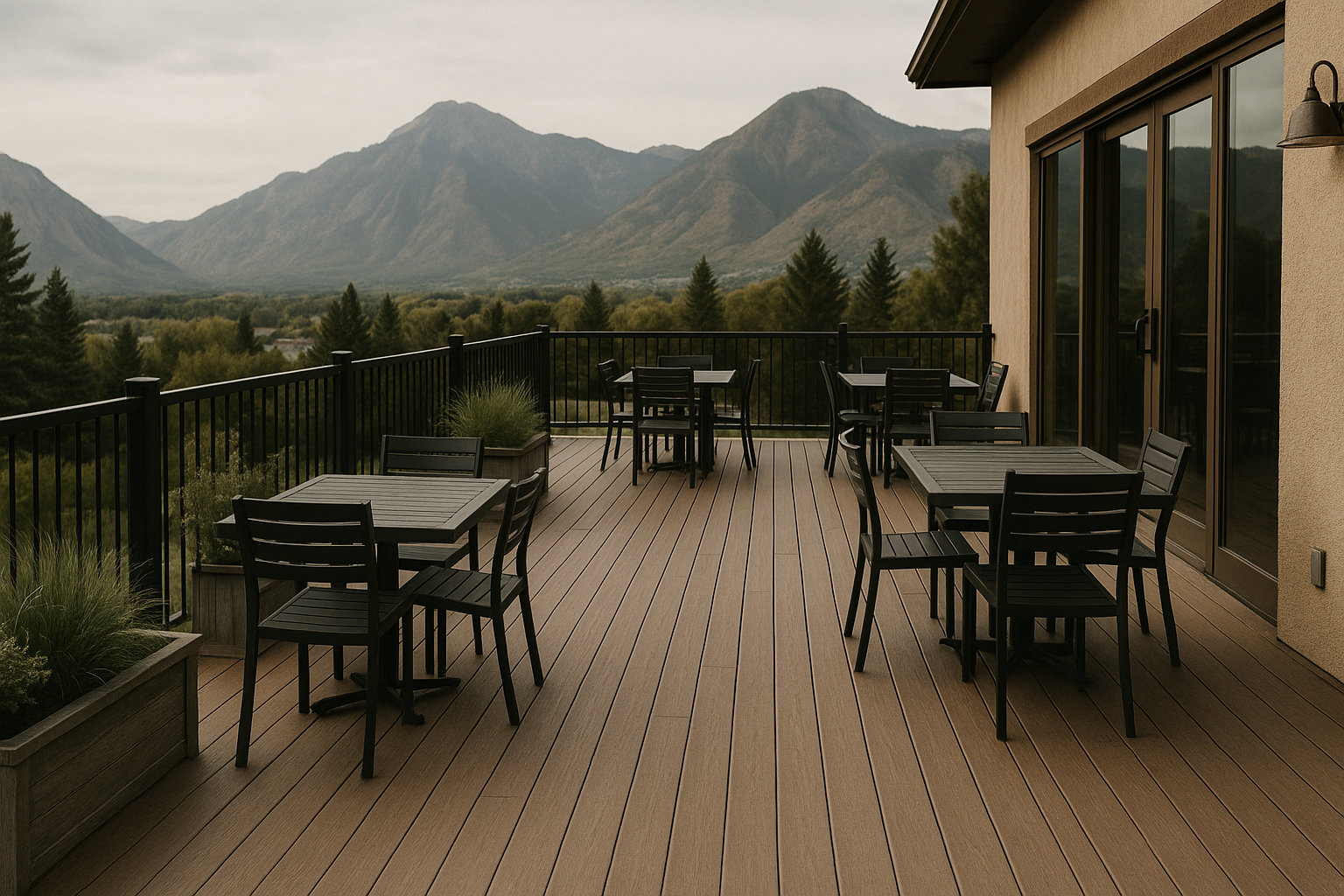
Outdoor dining isn’t a trend anymore—it’s part of how restaurants in Orem thrive. When patios stay open longer, tables turn faster, and the vibe makes people linger. But here’s the thing: a patio that looks great in May can struggle by January. Heavy foot traffic, spilled sauces, UV at elevation, freeze-thaw cycles, and weekly power-washing put real pressure on materials. That’s where we come in. At Utah County Decks, we design and build durable Decking for restaurants that need to work hard, look sharp, and meet code—all while earning their keep year after year.
Table of Contents
- What “durable” really means for restaurant decks
- Orem’s climate and code: what your deck has to survive
- Materials that last: composite, PVC, hardwood, and more
- Strong bones: framing that stands up to service
- Slip-resistance, edges, and lighting: the safety trio
- Cleaning without damage: a quick, realistic playbook
- Make the layout work hard: guests, servers, and flow
- Brands that behave under pressure
- Costs and the long game (because ROI matters)
- Common pitfalls—and how we steer around them
- Seasonal strategy for Utah County patios
- Our process: fast, thoughtful, and built for restaurants
- A quick case-type: small space, big return
- Ready to build a tougher, better-looking restaurant patio?
What “durable” really means for restaurant decks
Durability isn’t just about not breaking. It’s about staying safe, easy to clean, and good-looking during a busy Friday night and a snowy Tuesday morning. For restaurants, a deck has to handle grease near the kitchen door, high heels near the bar, chair scrapes during turnovers, and disinfectants during cleaning. It should shed water, resist stains, and offer grip when wet. And—this one’s underrated—it needs to control movement and noise so guests feel comfortable, not rattled.
Honestly, durability is part material and part strategy. With the right surface, the right framing, and the right maintenance plan, your patio can handle Utah’s four seasons without acting moody.
Orem’s climate and code: what your deck has to survive
Our weather in Utah County swings. Dry heat in summer, ultraviolet that’s a bit stronger at elevation, then snow, melt, and re-freeze in winter. Those changes stress decking and fasteners. We plan for it.
Let me explain how that ties into code and comfort:
– Snow and freeze-thaw: Surfaces expand and contract. Joints need room. Hidden fasteners matter. So do drain paths under the boards.
– Slip resistance: For commercial spaces, we aim for a wet coefficient of friction around 0.6 or higher. Texture and capstock matter.
– Orem permitting: We coordinate with Orem City for permits, structural review, and inspections. Commercial guard rails usually need 42-inch height. Stair nosings need consistent rise and run. Guards can’t allow a 4-inch sphere to pass.
– ADA access: Slopes near 1:48, smooth transitions, 36-inch clear routes, and strategic landings. Guests shouldn’t “feel” the compliance—it should just feel easy.
– Fire safety: If you’re adding heaters or a fire feature, we use heat-resistant zones and clearances. Some boards carry Class A or B ratings; we’ll match the right ones.
You know what? These details are the difference between “works… for now” and “works all year.”
Materials that last: composite, PVC, hardwood, and more
Wood has soul. We love it. But for restaurants with heavy cleaning and spill risk, composites and PVC often make more sense. They resist stains better, shrug off moisture, and keep a steady look.
Here’s a simple snapshot of durable choices we install around Orem:
| Material | Typical Lifespan | Best For |
|---|---|---|
| Composite Decking (Trex Transcend, Deckorators) | 20–25+ years | Restaurants needing toughness, rich color, and value |
| PVC Decking (TimberTech AZEK) | 25–30+ years | High exposure, top stain resistance, easy cleaning |
| Mineral-Based Composite (Deckorators MBC) | 25–30+ years | Low expansion, strong spans, heat + cold swings |
A few fast pointers:
– Composite decking is tough, budget-steady, and comes in textures that hide scuffs. Brands like Trex Transcend and Deckorators Voyage hold up well to foot traffic and chair movement.
– PVC decking like TimberTech AZEK brags top-tier stain resistance. Great near a bar or kitchen exit where spills happen daily.
– MoistureShield can handle tough moisture conditions. It’s a good choice if your deck sits near irrigation or over a roof area that may trap humidity.
– Hardwoods such as Ipe look beautiful and wear like iron, but for restaurants the maintenance can be fussy—seasonal oiling, careful cleaning, and heat checks.
– Pedestal pavers over a waterproof membrane can work for rooftop patios, but we’ll check structural capacity and wind uplift first.
There’s a wrinkle: darker colors look sleek but run hotter in July. We can offset that with shade and smarter color mix. A lighter field with darker borders keeps the style without scorching toes.
Strong bones: framing that stands up to service
Boards get the spotlight, but framing sets the deck’s lifespan. For long-running restaurants, we love steel framing systems such as Fortress Evolution—straight, fire-resistant, and dimensionally stable through seasons. If we go with pressure-treated lumber, we protect it like crazy.
What we do behind the scenes:
– Waterproofing the frame with joist and beam tapes such as Trex Protect or butyl tapes. Keeps water off fastener points.
– Right spacing for commercial traffic. Tighter joist spacing under high-chair areas to limit flex and wobble.
– Hidden fasteners where possible. Cleaner look, fewer snags, easier sanitizing. For PVC, we pair with the correct adhesive at seams.
– Ventilation to avoid trapped moisture. Decks breathe; if they can’t, they fail early.
It’s simple: a stable frame cuts noise, bounce, and call-backs. Guests feel the difference, even if they can’t name it.
Slip-resistance, edges, and lighting: the safety trio
Good traction is non-negotiable. We choose board textures designed for wet grip and consider directional patterns where staff move most. Near stairs, we add subtle nosing strips or contrasting borders for visibility. It looks upscale and reads safer.
We also design for light. Low-glare LED step lights, rail lights, and under-cap lighting guide traffic without blinding diners. And yes, it has to stand up to pressure washing. We route and seal wiring so connections stay tight.
One caution: rubber-backed mats can discolor certain decking over time. We’ll recommend mat materials that won’t stain your boards.
Cleaning without damage: a quick, realistic playbook
Restaurant patios see everything. Ketchup, red wine, sunscreen, fryer oil—sometimes all in a day. Your deck should take it in stride. But it needs the right cleaning routine.
– Nightly or weekly: Sweep, rinse, and spot-treat grease. Use mild detergents approved by the manufacturer. Soft-bristle brushes, not wire.
– Monthly: Check high-traffic seams and around host stands. Tighten hardware if needed. Watch for anything that collects water.
– Seasonal: A deeper wash, with the correct tip on the pressure washer. Keep it gentle; most boards like lower PSI with a wide fan tip. Reseal minor caulk joints where posts meet surfaces.
Skip rock salt in winter. Many boards don’t like it, and neither do metal fasteners. We suggest calcium magnesium acetate or a manufacturer-approved alternative, plus quick snow removal with a plastic shovel.
Make the layout work hard: guests, servers, and flow
A great patio feels effortless. You sit down, the server has a clean path, and the host can see every table. That doesn’t happen by accident.
We think through:
– Service alleys wide enough for trays and two-way traffic.
– Table spacing for comfort and ADA access. A few extra inches can prevent a dozen headaches.
– Heater and fan placement for even comfort. Gas lines and clearances planned early—saves money later.
– Shade and snow: Pergolas, sail shades, or umbrellas that can survive wind and shed snow. We plan anchor points into the frame.
– Acoustics: Rubber isolation pads on posts or under steel can cut vibration. Low-voltage speakers tucked into rails soften the soundscape.
It’s funny—people remember the fries and the breeze. They also remember when chairs wobble or the aisle is cramped. We aim for the former.
Brands that behave under pressure
We’ve tried a lot of Products on Utah patios. Some names keep proving themselves:
– TimberTech AZEK (PVC): Excellent stain resistance. Cooler feel underfoot in lighter colors. Great near bar areas.
– Trex Transcend (Composite): Durable shell, strong traction patterns, broad color range that hides scuffs.
– Deckorators Voyage/MBC: Mineral-based core with minimal expansion and great spanning; solid in temperature swings.
– Fortress Evolution (Steel Framing): Straight, predictable, and resistant to rot or insects. Plays nice with commercial loads.
We match the brand to your menu, traffic, and cleaning reality. A coffee shop with pastries and power-washing is different from a steakhouse with a lively bar and heaters.
Costs and the long game (because ROI matters)
Let’s be real: restaurant decks are a business decision. Upfront cost is one thing. Long-term cost is the bigger story. Composites and PVC usually win over time with fewer refinish cycles, less downtime, and fewer emergency fixes.
Where the money goes:
– Structure: The bones carry everything. Steel framing costs more but spreads payback over decades.
– Surface: Premium boards reduce stain stress and time spent scrubbing—real savings when labor is tight.
– Lighting and heat: Guests stay longer if they’re comfortable. That can move the revenue needle.
– Permits and design: We handle the paperwork. Clean drawings prevent onsite surprises.
We’ll be honest if a good mid-range composite makes more sense than a top-tier PVC for your concept. Not every patio needs the same armor.
Common pitfalls—and how we steer around them
It’s easy to overbuild one part and miss the quiet failure somewhere else. We’ve seen it.
– Dark-only color palettes: Looks great on Instagram, too hot in July. We mix tones and add shade so guests stay longer.
– No drainage path: Water stuck under boards kills a deck. We plan airflow and pitch, especially on rooftop patios.
– Under-spaced joists: High chair traffic and carts need tighter spacing. Bounce is bad for wine glasses and nerves.
– Random accessories: Heaters, planters, fans—add them late and you pay twice. We anchor the plan early, then build to it.
If you’re already working with an architect or GC, we’ll coordinate and make sure the deck package fits the broader plan.
Seasonal strategy for Utah County patios
Patio season is longer than you think when you design for it. Radiant-style heaters, wind-smart railings, and strategic lighting extend shoulder months. We also plan for quick transitions—covers that come off fast, snow that clears fast, furniture that stacks without scratching boards.
Spring: inspect fasteners, reset furniture glides, refresh lighting timers.
Summer: shade and airflow count more than anything. We like fans under pergolas for gentle movement.
Fall: check caulks, re-level a few tables, swap in heavier umbrella bases.
Winter: move snow early, use approved de-icers, and keep clear exit paths for code.
Small habits keep a deck looking new.
Our process: fast, thoughtful, and built for restaurants
Working on a restaurant schedule can be tricky—we get it. We plan to minimize disruption.
– Consult and concept: We listen first. Menu style, hours, service flow, dream list. Then we sketch.
– Material match: We bring samples. Composite decking, PVC decking, rail systems, lighting. You’ll feel textures and see colors in daylight.
– Permits and engineering: We handle Orem City paperwork, coordinate with inspectors, and line up structural details for snow load and guard heights.
– Build schedule: Off-hours, shoulder-season, or phased work—whatever gets you open with less pain.
– Final walk and care guide: Your team gets a simple maintenance cheat sheet and manufacturer contacts. No mysteries.
We stay reachable. If something creaks, we’re back to fix it.
A quick case-type: small space, big return
A local cafe had a tight side yard. Three two-tops, a server station, and a heater seemed like a stretch. We used mineral-based composite to keep board movement low, added a steel frame to slim down the structure, then tucked LED lights into the stair riser and rail cap. A light top board with a walnut border kept heat down but gave the room some polish. The result? Winter coffee, summer brunch, and lines on Saturdays.
No, it’s not magic. It’s planning plus materials that behave.
Ready to build a tougher, better-looking restaurant patio?
If you’re in Orem or anywhere in Utah County, we’d love to help you plan a patio that works as hard as your kitchen. Utah County Decks brings restaurant-aware design, code-ready builds, and materials that shrug off heavy use. We’ll talk layout, traffic, heaters, cleaning, and budget—then turn it into a deck your guests ask for by name.
Call us today at 801-406-3726 or Request a Free Quote. We’ll meet you on-site, run through options, and map out a deck that carries your brand—and your weekends—through every season in Orem.