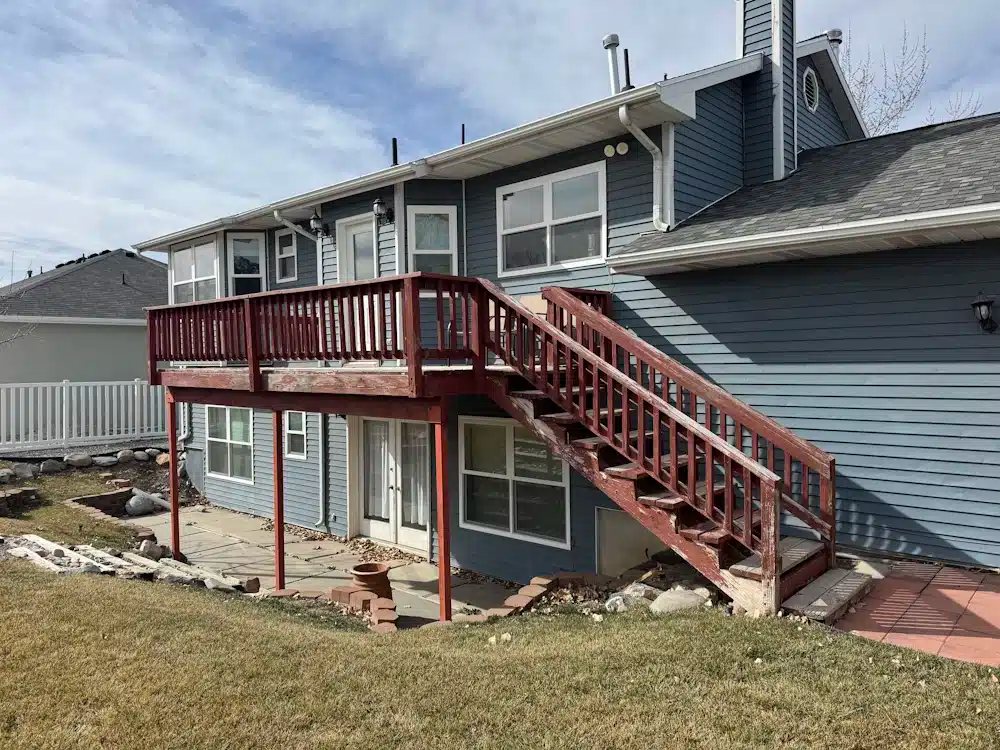
A worn deck does not always need to be replaced. Some decks only need isolated board repairs, better fasteners, a railing correction, or a focused stair fix. Other decks are past the point where cosmetic repairs make sense. The hard part for a homeowner is that the most important problems are often under the surface, behind the ledger, inside a stair connection, or hidden where water has collected for years.
This Utah County guide gives you a practical way to think through repair, resurfacing, removal, and full replacement. It is not a substitute for an on-site inspection or a city review, but it explains the safety signs, code topics, and investment questions that should come before anyone covers an old deck with new boards.
Start with safety, not appearance
Deck decisions often begin with what homeowners can see: faded boards, peeling stain, warped rail caps, or stairs that look dated. Those details matter, but they are not the first question. The first question is whether the deck safely carries people, furniture, snow, and everyday movement. A deck that looks old may still be repairable. A deck that looks acceptable may still have unsafe connections or rot.
NADRA deck safety resources encourage homeowners and professionals to evaluate key parts of a deck instead of treating the surface as the whole structure. The typical evaluation includes boards, joists, beams, posts, footings, ledger connections, stairs, guards, handrails, fasteners, flashing, and signs of decay or movement. Simpson Strong-Tie also publishes deck connection guidance because ledger, joist-to-beam, beam-to-post, stair, and guard connections are central to deck performance.
If a deck moves when people walk on it, if a railing can be pushed back and forth, if stairs bounce or lean, or if framing feels soft underfoot, the project should be treated as a safety evaluation before it is treated as a repair estimate. A new surface does not solve a weak load path.
Utah County weather makes small problems grow
Utah County decks live through strong sun, dry summers, winter snow, freeze-thaw cycles, wind, and fast temperature swings. Older wood decks can dry out, split, cup, and open gaps. Shaded areas can hold moisture. Stair stringers and ledger areas can collect water. South- and west-facing boards may weather differently from covered or north-facing boards on the same deck.
This climate does not mean every deck fails early. It means repairs should be based on actual condition, not age alone. A covered deck with good drainage and sound framing may be a repair candidate. An exposed elevated deck with water trapped at the ledger, loose guard posts, and soft stair stringers may be a replacement candidate even if some boards still look usable.
Local context also matters because deck height, lot slope, door location, snow shedding from roofs, and yard drainage all affect risk. A low platform deck in a flat Orem backyard is a different decision than an elevated deck on a sloped lot in Highland, Eagle Mountain, or Woodland Hills.
When a repair may be enough
A targeted repair can be a good investment when the structure is fundamentally sound and the problem is isolated. Examples include a small group of damaged deck boards, a stair tread that needs replacement, loose trim, minor railing hardware issues, or a localized area of wear caused by a planter, grill, or roof drip. In those cases, the repair should solve the actual defect without turning into an unnecessary rebuild.
The key word is isolated. If a few boards are bad because a planter trapped moisture, the solution may be straightforward. If many boards are soft, joists below them are dark or punky, and fasteners are corroded, the visible boards are probably only the first symptom. A responsible repair estimate should include a structure check before promising that the deck can be saved.
Repair also makes sense when the homeowner's goal is short-term safety while planning a larger project later. In that case, the scope should be honest. A limited repair is not the same as restoring the deck to new condition. The builder should explain what is being fixed, what is being left alone, and what signs would trigger a replacement conversation.
When resurfacing can make sense
Resurfacing means removing old deck boards and installing new decking on the existing frame. This can be a smart middle path when the frame is sound, properly spaced, and suitable for the new boards. It is common for homeowners to consider resurfacing when they want to move from stained wood to composite or PVC decking without rebuilding every structural component.
Resurfacing is not automatically cheaper in the way people expect. The old deck still has to be opened, evaluated, repaired where needed, and prepared for the new surface. Joist spacing may need adjustment. Blocking may be required for rail posts, seams, or picture framing. Fascia, stairs, railing, and fasteners may need upgrades to make the finished deck look intentional instead of half-new and half-old.
Manufacturer installation guides matter here. Composite and PVC boards have specific fastening, gapping, blocking, and installation requirements. If the old frame cannot support those details cleanly, resurfacing can become a poor investment. A resurfacing proposal should state what framing corrections are included and what hidden conditions could change the recommendation.
When replacement is the safer choice
Replacement is usually the better path when the deck has structural deterioration, unsafe stairs, failing guards, major ledger concerns, inadequate footings, or widespread rot. It may also be the better path when the existing layout is the real problem. A deck that is too narrow, poorly connected to the yard, awkward at the stairs, or blocking a better outdoor-living plan may not deserve another round of patching.
The International Residential Code includes an exterior deck section, guard and stair provisions, and framing requirements that affect how a new or substantially rebuilt deck is planned. The American Wood Council's DCA6 guide is a common prescriptive reference for residential wood deck construction. These resources show why a deck is a structural system, not a collection of replaceable boards.
Replacement also gives the homeowner a chance to correct old compromises. The new deck can have better stair placement, wider landings, safer guardrails, composite decking, coordinated fascia, improved drainage, shade, lighting, privacy, and a layout that matches how the family actually uses the yard. If repair cost is climbing toward a project that still leaves you with the same flawed deck, replacement may be the more rational investment.
Deck connections are often the deciding issue
A deck is only as good as the path that carries loads into the ground and, where attached, into the house. Simpson Strong-Tie describes its deck connection and fastening guide as a resource for recognizing defects in existing decks and understanding connection options for ledger connections, joist-to-beam connections, beam-to-post connections, and related details. Those connection points are where many repair-or-replace decisions become clear.
Ledger problems deserve special caution. The ledger is the board or assembly that connects an attached deck to the house. If it is poorly fastened, inadequately flashed, decayed, or attached to unsuitable material, the deck can be unsafe even if the walking surface looks acceptable. Water damage at the house connection is also one of the problems homeowners are least likely to see from above.
Posts, beams, and footings matter just as much. A post sitting directly in soil, a beam with major checking or rot, a notched support that was never appropriate, or a footing that has moved with frost or settlement can push the project toward replacement. A builder should be able to explain these findings in plain language rather than hiding behind vague warnings.
Stairs and railings should not be treated as accessories
Many homeowners first notice a problem when the railing feels loose or the stairs feel springy. Those are not small details. Guards, handrails, stair risers, treads, landings, post connections, and blocking all affect daily safety. The IRC includes stair and guard sections because falls from decks and stairs are exactly the kind of risk residential codes are meant to reduce.
A loose railing may be a simple fastener repair, but it can also indicate rotted blocking, weak posts, poor original construction, or decay in the rim joist. A stair problem may be limited to one tread, or it may show that the stringers are undersized, decayed, poorly supported, or out of alignment. The repair recommendation should match the cause, not just the symptom.
If a deck is being resurfaced, it is usually smart to evaluate railing and stairs at the same time. New composite boards next to old unstable railing make the project feel unfinished and can leave the most important safety issue untouched.
Permits and local review can affect the decision
Utah County's Building Division states that it serves unincorporated Utah County and directs city properties to their city's services or website. It also explains that permits are required before certain building or construction work regulated by adopted codes, with exemptions handled through the Building Official. Cities such as Saratoga Springs publish their own permit requirements and adopted codes. That means the repair-or-replacement decision should include the property's jurisdiction.
Small maintenance work and like-for-like repairs may be handled differently than structural alterations, elevated deck rebuilding, stair changes, roof or shade additions, or electrical work. Do not assume the answer based on a neighbor's project. The safer process is to identify the scope, identify the jurisdiction, and confirm what review is needed before construction begins.
Permit review can feel like a delay, but it can also protect the homeowner. If the project involves footings, ledgers, guards, stairs, or major framing, review and inspection can help ensure the finished deck is more than cosmetically improved.
How upgrades change the repair decision
The repair decision changes when the homeowner wants more than a safe patch. Adding composite decking, new railing, wider stairs, a privacy screen, lighting, or a shade structure can expose the limits of an old frame. A deck that could handle a small board repair may not be the right base for a more finished outdoor room. The more permanent the upgrade, the more important the underlying structure becomes.
Railing is a common example. New railing systems need dependable posts and blocking. If the old deck was built with minimal rail support, the builder may need to open the frame and add structure before installing the new rail. Stairs are another example. New deck boards on top of worn stair stringers can look better for a moment while leaving the most heavily used part of the deck weak, uneven, or uncomfortable.
Shade and hot tub plans raise the bar even further. Roofed covers, pergolas, pavilions, and hot tubs introduce loads and connections that should not be added casually to an aging deck. In those situations, replacement or substantial rebuilding may be safer than trying to adapt old framing. A good estimate should separate what is required for safety from what is optional for comfort and appearance.
A practical homeowner inspection checklist
- Walk the deck slowly and note any movement, bounce, sagging, or areas that feel soft underfoot.
- Push gently on railings and stair rails; movement should trigger closer inspection before any cosmetic upgrade.
- Look under the deck for dark, soft, split, or decayed joists, beams, posts, stair stringers, and blocking.
- Check where the deck attaches to the house for signs of water staining, missing flashing, separation, or decay.
- Look for corroded fasteners, missing connectors, unsupported beams, posts that contact soil, and unusual notches or cracks.
- Pay attention to stairs, landings, tread depth, riser consistency, handrail feel, and whether people naturally avoid parts of the stair.
- Notice drainage patterns, roof drip lines, sprinkler overspray, and shaded snow areas that may keep framing wet.
- Write down whether your real goal is a short-term repair, a safer surface, a better layout, or a complete outdoor-living transformation.
How to compare repair and replacement proposals
A useful proposal should explain the existing condition and the recommended scope. If one contractor proposes resurfacing and another proposes replacement, ask each of them what they saw in the ledger, joists, beams, posts, footings, stairs, and railings. The difference may be a genuine difference in condition assessment, or it may be that one proposal ignored hidden structural questions.
Avoid comparing only the final number. A repair proposal might exclude railing, stair improvements, permit help, framing corrections, fascia, demolition, disposal, or hidden rot. A replacement proposal might include a complete deck with new framing, stairs, railing, composite decking, and a cleaner layout. Those are not the same project.
Also ask what happens if hidden damage is found. With old decks, surprises are common once boards come off. A clear proposal should explain how change orders are handled, what conditions could stop a resurfacing plan, and when the builder would recommend switching to replacement.
How to decide when the inspection is inconclusive
Sometimes an old deck is not obviously safe or obviously doomed. In that middle zone, the best question is what uncertainty you are willing to buy. A small repair on a low deck with limited use may be reasonable when the risk is isolated. A cosmetic resurfacing on an elevated deck with unknown ledger conditions, old stairs, and loose guards is a much bigger gamble.
When the inspection is inconclusive, ask for options. One path may be limited repair with a clear expectation that it is not a long-term rebuild. Another may be partial replacement of the unsafe structural areas. The cleanest path may be full removal and new construction. The right answer depends on safety, budget, expected life, and whether the homeowner wants a temporary fix or a finished outdoor room.
How Utah County Decks approaches the decision
Utah County Decks starts by looking at the actual deck, not by forcing every homeowner into the same answer. If the structure is sound and the problem is isolated, repair or resurfacing may be appropriate. If the frame, ledger, stairs, or guards are unsafe, the honest recommendation may be removal and replacement. The right answer is the one that protects the homeowner and respects the budget.
The estimate conversation should also include what you want the space to become. Some homeowners only need safe access for a few more seasons. Others are ready for a composite deck, new railing, better stairs, a shade structure, and a completely different layout. Repair versus replacement is not just a technical decision. It is also a decision about how much value you want the deck to deliver in the next decade.
The before-and-after gallery can help frame that conversation. Seeing how an aging elevated deck, awkward side-yard deck, or covered porch can be transformed helps homeowners decide whether they are trying to fix a problem or create a better outdoor space.
Helpful next steps
Common questions
Can an old deck be repaired instead of replaced?
Sometimes. If the main structure is sound and the problems are isolated, repair can be a good option. The deck should still be checked for hidden rot, weak connections, loose guards, and stair problems before the decision is made.
Is resurfacing cheaper than replacement?
It can be, but only when the existing frame is worth saving. Resurfacing still requires demolition, inspection, framing corrections, compatible installation details, and often new railing or stair work.
When is deck replacement the safer choice?
Replacement is usually safer when there is widespread rot, ledger damage, failing posts or beams, unstable stairs, loose guards, inadequate footings, or a layout that no longer makes sense to repair.
Do deck repairs need permits in Utah County?
It depends on the jurisdiction and scope. Cosmetic maintenance may be different from structural work, stair changes, elevated deck rebuilding, or shade additions. Verify requirements with the county or city before work begins.
Should I put composite boards on an old wood frame?
Only if the frame is sound, properly spaced, adequately blocked, and appropriate for the chosen decking. New composite boards should not be used to hide weak or decayed structure.
What should I prepare before a repair estimate?
Take photos of the deck from above and below, note soft areas or movement, identify stair and railing concerns, and be ready to explain whether you want a short-term repair or a long-term replacement plan.
Sources and references
- NADRA deck safety resources
- NADRA deck evaluation guide
- Simpson Strong-Tie deck connection and fastening guide
- ICC 2021 IRC exterior decks section R507
- ICC 2021 IRC guards section R312
- ICC 2021 IRC stairs section R311
- AWC DCA6 deck construction guide
- Utah County Building Division
- Saratoga Springs building permit requirements
Want this translated into a real deck plan?
Send the project details and Utah County Decks will help sort out scope, materials, repairs, shade, railing, and the cleanest next step.