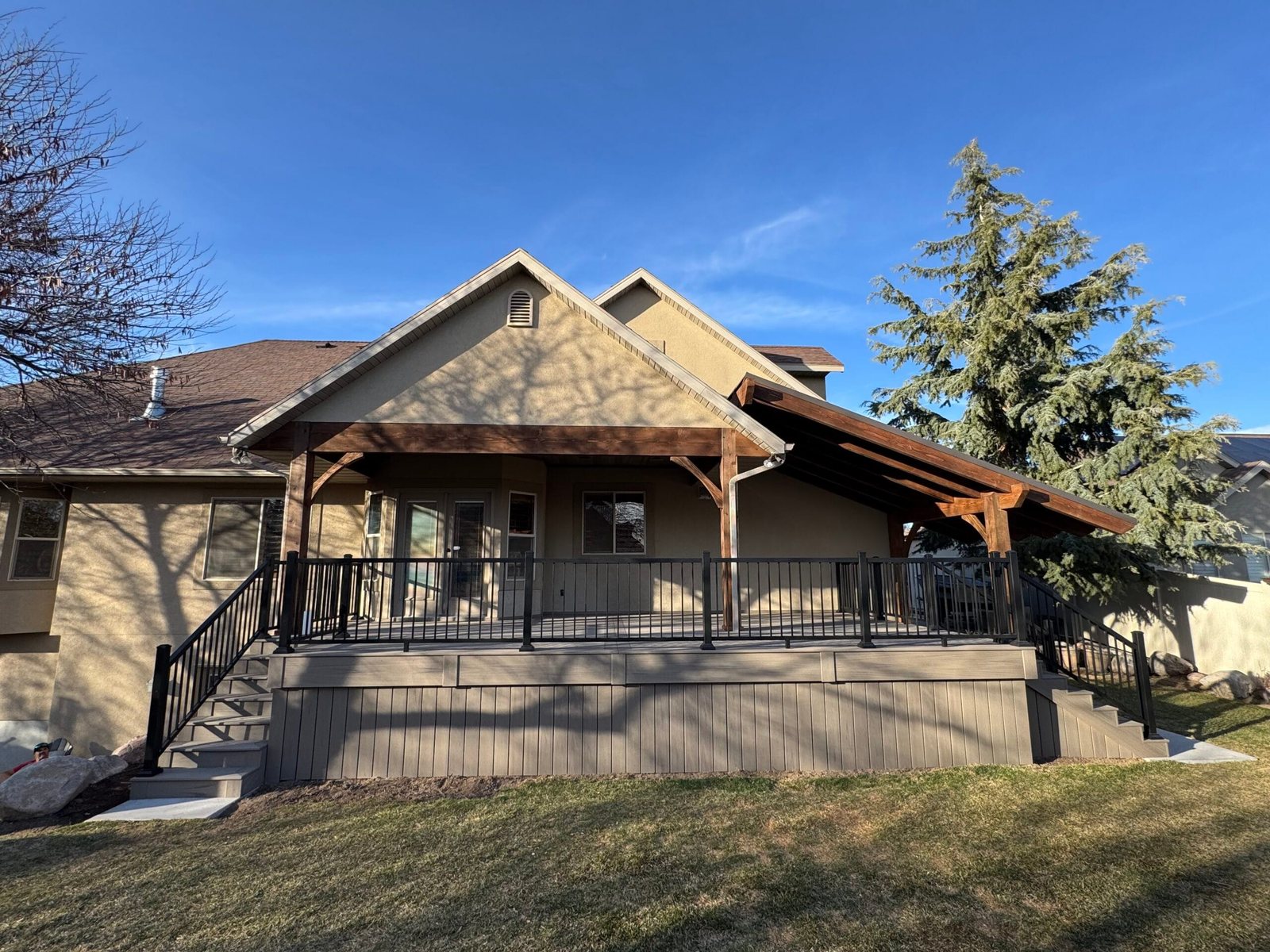
Choosing a deck builder in Utah County is partly about workmanship, but it is also about judgment. A good builder has to understand local permitting, snow and frost conditions, ledger attachment, stairs, guards, railing systems, composite product details, and how the new outdoor space should fit the home instead of looking like an add-on.
This guide is written for homeowners in Lehi, Orem, Provo, Spanish Fork, Saratoga Springs, Eagle Mountain, American Fork, Pleasant Grove, Springville, and nearby Utah County communities who want a safer way to compare contractors. Use it before you sign a proposal, especially if the project includes an elevated deck, composite decking, railing, stairs, deck removal, repair, or a shade structure.
Start with the kind of deck you are really building
The right contractor depends on the project. A simple ground-level platform behind a newer home is a different job than a second-story deck with stairs, a ledger attached to the house, railing, demolition, lighting, privacy screening, and a covered section. Before comparing names, describe the project in plain terms: new build, replacement, resurfacing, repair, covered deck, Trex upgrade, railing replacement, or full backyard outdoor room.
That first definition keeps the estimate honest. Some contractors are comfortable replacing surface boards but not evaluating an old ledger or stair system. Others can build a new deck but do not help with material selection. A Utah County homeowner should look for a builder whose experience matches the risk of the job, not just someone who says they build decks.
Verify the basics before judging the photos
Project photos are useful, but they should not be the first proof you trust. Utah offers a public professional license lookup through DOPL, and homeowners can use it to check a contractor's license status before they hire. The lookup is not a substitute for good judgment, but it is a simple first screen. If the name on the bid, business card, contract, and license record do not line up clearly, pause and ask questions.
Insurance should also be part of the conversation. A deck project involves demolition, framing, stairs, railing, fasteners, saws, deliveries, and people working around your home. Ask whether the contractor carries the insurance required for their work and whether they can provide documentation. A serious builder should not be offended by basic due diligence.
- Look up the business or qualifying individual in the Utah professional license lookup.
- Confirm the bid comes from the same business you are actually hiring.
- Ask for proof of insurance before work begins, not after a problem.
- Be cautious if a contractor wants large cash payments, avoids written scope, or asks you to pull a permit as if the project were your own work.
Choose a builder who understands the local permit path
Utah County is not one permitting office. The Utah County Building Division says it serves unincorporated Utah County only and tells property owners inside a city to use that city's services or website. That matters because a deck in unincorporated county territory may follow a different process than a deck in Lehi, Provo, Orem, Spanish Fork, Saratoga Springs, or another city.
A contractor does not need to turn the first phone call into a code lecture, but they should know that the city or county jurisdiction comes first. They should ask where the home is located, whether there is an HOA, whether the deck will be attached to the house, whether it is elevated, and whether the work includes stairs, guards, electrical, a roof, or structural repair. If every answer is treated like a simple no-permit deck, you are not getting careful advice.
Ask what code topics affect the design
Utah's State Construction and Fire Codes Act adopts specific editions of nationally recognized codes, including the 2021 International Residential Code for residential work. Utah County's own building page lists the 2021 International Residential Code among its governing codes for unincorporated county projects. For homeowners, the practical point is simple: a deck is not just boards and railings. It is a structure that must carry people, snow, furniture, grills, and movement safely.
The International Residential Code includes an exterior deck section, commonly referenced as IRC R507, and separate sections for stairs, guards, and means of egress. A builder should be able to discuss the design topics without turning the homeowner into an engineer: footings, posts, beams, joists, ledger attachment, flashing, lateral restraint, stair geometry, guard height, rail spacing, handrails, and approved fasteners. The details are what keep a deck from feeling bouncy, leaking at the house, or failing at the connections years later.
Look for a site visit that studies the whole backyard
A strong estimate begins on site. The builder should look at door heights, siding, drainage, grading, utility locations, sprinkler heads, window wells, basement entrances, slopes, access for materials, existing concrete, privacy, sun exposure, and how stairs will land. In Utah County, they should also think about winter use, snow sliding from roofs, ice on stairs, freeze-thaw movement, and the way west-facing decks can become uncomfortable in late afternoon sun.
If an estimate is written from a few photos and a rough square footage number, it may be useful for early planning but it is not a complete scope. The surprises show up later: rotten framing, weak posts, unusable stairs, railing that was not included, fascia that costs extra, a door threshold that changes deck height, or demolition that takes longer than expected. A real visit reduces those surprises.
Compare proposals line by line, not just total price
Deck bids can look similar when the final number is the only thing you compare. The difference is usually in the assumptions. One bid may include demolition, disposal, footings, framing, flashing, joist tape, composite decking, hidden fasteners, fascia, picture framing, stairs, railing, permit help, and cleanup. Another may include only a basic platform with surface screws and no railing allowance. Both can be called a deck estimate, but they are not the same project.
Ask each builder to identify what is included and what is excluded. If the bid says Trex, ask which Trex line and color. If it says railing, ask which system. If it says stairs, ask how many stairs, where they land, whether handrails are included, and whether the stair framing is being replaced. If it says repair, ask how much existing structure is being reused and what happens if rot is discovered.
- Material line and color, not just brand name.
- Decking fastener style, fascia, trim, seam layout, and picture-frame details.
- Railing system, post sleeves, gates, stair rails, and handrails where needed.
- Demolition, disposal, protection of landscaping, and access assumptions.
- Permit support, plan details, inspections, and who communicates with the jurisdiction.
Make the contract as clear as the estimate
A detailed estimate should become a detailed agreement before construction starts. The contract should identify the contractor, property address, payment schedule, approximate start process, major materials, change-order process, cleanup expectations, warranty information, and what happens if hidden damage is found during demolition. It should also make clear whether the contractor is helping with permit paperwork, drawings, inspections, or manufacturer documentation.
Payment terms deserve special attention. A deposit may be normal, but the schedule should make sense for the work and materials. Avoid arrangements that leave you with very little leverage before the project is substantially complete. If a contractor is ordering special materials, ask how those materials are identified, when they arrive, and whether color, collection, and railing choices are confirmed in writing before orders are placed.
Change orders are not always a sign of a bad contractor. Hidden rot, unexpected framing problems, utility conflicts, or city corrections can be legitimate changes. The problem is a vague process. A strong builder explains how changes are priced, approved, documented, and scheduled so the homeowner is not surprised by a larger final invoice with little explanation.
Use safety questions to reveal experience
Deck safety organizations such as NADRA emphasize regular deck inspection and attention to connection points, stairs, railings, wood decay, fasteners, and movement. Homeowners do not need to know every technical detail, but they should listen for whether a builder treats safety as part of the job. A loose guardrail, a ledger without proper flashing, or stairs that feel uneven are not small cosmetic issues on an elevated deck.
Ask the builder what they look for on an older deck before recommending resurfacing. Good answers usually include framing condition, joist spacing, fastener corrosion, rot at the ledger, post bases, beam connections, stair stringers, guard posts, and whether the existing structure can support the new decking and railing. A builder who wants to install expensive composite boards over unknown framing is protecting the sale more than the homeowner.
Match materials to Utah County conditions
Material choice should be more than a color conversation. Utah County decks see strong sun, dry summers, snow, cold mornings, freeze-thaw cycles, wind, and dust. Darker composite boards can look rich but may feel hotter in direct sun. Lighter tones may stay more comfortable but need to work with the house exterior. Railing can preserve a mountain view or make a deck feel heavy. Shade can turn a pretty deck into a usable outdoor room.
A good builder helps you balance appearance, maintenance, heat, traction, warranty, budget, and the surrounding architecture. That is especially important when comparing Trex, TimberTech, wood, aluminum railing, composite railing, and shade structures. The best deck is not necessarily the most expensive deck. It is the one whose structure, materials, layout, and finish details match the way the family will use the space.
Read reviews for patterns, not perfection
Reviews are helpful when you read them for repeated patterns. Look for comments about communication, schedule, cleanup, problem solving, craftsmanship, change orders, and how the contractor handled unexpected issues. A single short five-star review says less than a pattern of homeowners saying the builder explained choices clearly and followed through.
Also look at the kinds of projects shown. If you want an elevated composite deck with a finished stair run and railing, photos of small ground platforms may not prove enough. Before-and-after examples can be especially useful because they show whether the builder can solve layout and repair problems, not just photograph a finished surface.
Ask how the builder communicates during construction
Deck projects are visible, noisy, and disruptive for a short period of time. Good communication keeps that disruption manageable. Ask who your day-to-day contact will be, how schedule changes are shared, when materials are delivered, where debris will go, and whether the crew needs driveway access, side-yard access, pets secured, or sprinkler zones marked. These small details prevent frustration once work begins.
Communication also matters when an inspector requests a correction or the builder uncovers a problem under an old deck. The right response is not panic or blame. It is a clear explanation of what was found, why it matters, what options exist, how the cost changes, and whether the schedule is affected. Homeowners remember the way problems are handled more than the fact that a normal construction problem occurred.
Watch for red flags before you sign
The biggest warning sign is vagueness. A vague scope creates room for conflict because the homeowner thinks one thing is included and the contractor thinks another. Other warning signs include pressure to sign immediately, no written contract, no material details, no permit discussion, no plan for stairs or railing, reluctance to discuss license status, and a price that seems too low because it leaves out major work.
A good contractor may not have every answer during the first conversation, but they should have a process for getting the answer. They should be willing to say when a repair is not wise, when an old frame needs deeper review, when a city should be contacted, and when a desired design may need to change because of structure, stairs, drainage, or budget.
A practical way to compare two or three builders
If you have more than one proposal, put them into the same format before deciding. Write the project goal at the top of the page, then list demolition, framing, decking, railing, stairs, fascia, permits, cleanup, and exclusions as separate rows. A bid that looks higher may be the only one that includes the actual work you assumed was included.
This comparison also protects the relationship with the contractor you choose. When everyone knows the deck line, railing system, stair assumptions, repair allowance, and change-order process before work starts, the project is less likely to turn into a tense argument later. Good builders do not mind clarity. Vague builders rely on the homeowner not noticing what is missing.
- Ask each builder to identify the exact decking line, not just composite or Trex.
- Ask whether the railing, stair rails, fascia, picture framing, and disposal are included.
- Ask what conditions would change the price after demolition starts.
- Ask who handles inspections, manufacturer documents, and final walkthrough details.
Use the first meeting to test problem solving
The first meeting should give you a feel for how the builder thinks. A strong contractor will not just say yes to every idea. They will notice the grade, the door threshold, the way water moves, the condition of the existing deck, the relationship between stairs and landscaping, and whether the requested material choice fits the budget and exposure. That kind of pushback is useful because it protects the finished result.
Listen for clear explanations instead of memorized sales lines. If you ask why a stair should land in one place instead of another, the answer should connect to safety, traffic flow, grade, inspection, or cost. If you ask why one railing system is better than another, the answer should connect to view, maintenance, code, and style. The builder who explains tradeoffs clearly before the contract is usually easier to work with after construction begins.
How Utah County Decks approaches the decision
Utah County Decks uses the estimate conversation to connect the parts homeowners often separate: design, structure, permits, materials, railing, stairs, shade, demolition, and the finished look. That does not mean every project needs every upgrade. It means the scope should be clear enough that the homeowner understands what they are buying and why it fits the property.
If you are early in planning, review the service pages, browse the gallery, and write down what you like about each project. Then request an on-site estimate with photos, rough dimensions, material preferences, and any HOA or city concerns you already know about. The more specific the conversation is, the easier it is to compare the proposal fairly.
Helpful next steps
Common questions
How do I check if a Utah deck contractor is licensed?
Use Utah's official professional license lookup and search the contractor or business name before hiring. Also confirm that the name in the lookup matches the company on the proposal and contract.
Should I choose the cheapest deck builder?
Not automatically. A low number can be fine if the scope is complete, but many cheap bids leave out railing, stairs, demolition, fascia, permit support, or structural repairs that appear later as change orders.
What should a deck estimate include?
A useful estimate should identify the size, structure, major materials, decking line, railing system, stairs, demolition, repair assumptions, trim details, permit expectations, payment schedule, and what is excluded.
Can a builder quote from photos only?
Photos can help with early budgeting, but a full proposal is stronger after an on-site visit because deck height, drainage, access, door thresholds, existing framing, stairs, and railing conditions affect the project.
Can Utah County Decks help compare Trex, TimberTech, railing, and shade options?
Yes. Material guidance is part of the estimate process, especially when the project includes composite decking, railing upgrades, stairs, or a covered outdoor living area.
Sources and references
Want this translated into a real deck plan?
Send the project details and Utah County Decks will help sort out scope, materials, repairs, shade, railing, and the cleanest next step.