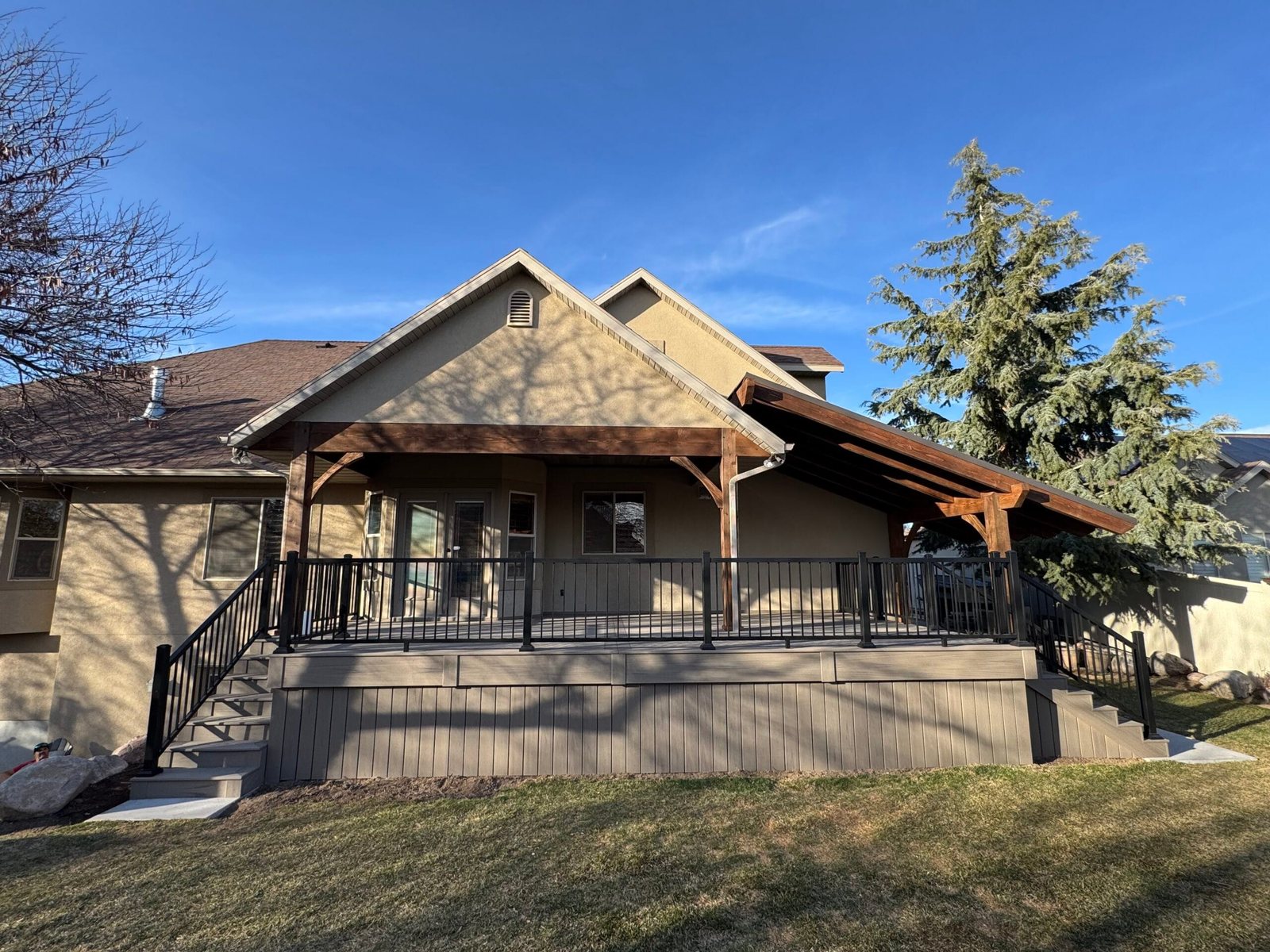
Deck cost in Utah County is not a single square-foot number. That would be convenient, but it would also be lazy. A ground-level composite platform, an elevated walkout deck with stairs, a resurfacing job over existing framing, and a covered outdoor room can all have similar surface area and very different real budgets.
This guide is written for homeowners comparing deck builders in Provo, Lehi, Orem, Saratoga Springs, Eagle Mountain, American Fork, Pleasant Grove, Spanish Fork, Springville, Payson, and nearby cities. It explains the cost drivers that actually matter before an on-site estimate: structure, access, materials, stairs, railing, code, permits, demolition, shade, and how much of the existing deck can honestly be reused.
The short answer on Utah County deck cost
The price of a deck is driven by the complete scope, not just the deck boards. Size matters, but height, structure, stairs, railing, demolition, access, finish details, and material line can move the number just as much. A low deck with simple access is a different job than a second-story deck with long stairs, guardrails, fascia, demolition, and permit review.
Manufacturer calculators from brands like Trex and TimberTech are useful for early education because they help homeowners think about dimensions and materials. They are not a substitute for a real property visit. A calculator cannot inspect old framing, identify rot, understand local permit requirements, see stair landing constraints, or know whether a covered section should be part of the design.
The cost drivers homeowners underestimate
Most homeowners expect decking boards to drive the budget. They matter, but the quiet budget movers are often the pieces around the boards. Stairs, guardrails, fascia, trim, picture-frame borders, demolition, old-frame repairs, footings, beams, and access can change the job fast.
A serious estimate should separate those items instead of hiding everything behind a single number. That makes bids easier to compare and keeps the project from turning into a change-order parade after work starts.
- Height: elevated decks require more structural planning, posts, beams, stairs, guards, and inspection attention.
- Stairs and landings: stair direction, width, railings, handrails, and where the stairs meet the yard affect both safety and labor.
- Railing: aluminum, composite, cable-style, vinyl, and other systems vary widely in cost and appearance.
- Demolition: old deck removal, disposal, hidden rot, and site cleanup should be included if the project is a replacement.
- Finish details: fascia, skirting, borders, hidden fasteners, stair risers, plugs, and trim decide whether the deck looks finished.
- Access: tight side yards, slopes, landscaping, fences, sprinkler lines, and material staging can affect labor.
New deck, replacement deck, or resurfacing?
A new deck starts with layout and structure. A replacement deck starts with demolition and the decision of whether the old footprint should be reused. Resurfacing starts with a tougher question: is the old frame actually worth saving?
Resurfacing can be a smart way to control cost when framing is sound, properly spaced, and structurally appropriate for the new decking. It is a bad investment when the frame is rotted, moving, poorly attached, underbuilt, or tied to unsafe stairs and railings. Expensive composite boards over a bad frame are just expensive camouflage.
Composite and PVC boards change maintenance, not the whole scope
Trex states that its composite decking does not require sanding, painting, staining, or sealing. TimberTech describes its composite and Advanced PVC decking as real-wood-look products designed for lower upkeep than traditional wood. Those are useful advantages, especially in Utah County sun and snow, but the board choice is still only one part of the deck.
A complete composite deck estimate should still address framing, ventilation, fasteners, stairs, railing, fascia, trim, drainage, and local requirements. The better the visible surface, the more obvious it becomes when the structure and finish details are weak.
Permits and code can affect budget
Utah County says its Building Division serves unincorporated county areas and directs properties inside cities to use the city service or website. That matters because a deck in Provo, Lehi, Orem, Saratoga Springs, Spanish Fork, or another city may follow that city process instead of the county process.
Utah Code Title 15A adopts statewide construction codes, including editions of nationally recognized codes. For deck planning, the practical point is simple: elevated decks, stairs, guards, ledgers, footings, and structural changes deserve careful review. Permit help, drawings, inspections, and corrections can affect schedule and cost, so they should not be treated as an afterthought.
How to compare two deck estimates without getting burned
Put the estimates into the same format. List demolition, framing, decking line, railing system, stairs, fascia, fasteners, trim, permit assumptions, cleanup, and exclusions. A bid that looks higher may simply include the work the cheaper proposal left vague.
Also ask what happens if hidden damage is found. Old decks can hide rot, bad ledger attachment, soft framing, stair problems, and fastener corrosion. A good contractor explains the discovery process before demolition starts.
- Ask which exact deck board line and color are included.
- Ask which railing system is included, not just whether railing is included.
- Ask whether demolition and disposal are included.
- Ask whether fascia, stair risers, hidden fasteners, and trim are included.
- Ask what permit, inspection, and city coordination assumptions are included.
- Ask what conditions would change the price after the old deck is opened up.
The smartest way to control deck cost
The smartest way to control cost is to simplify the design without weakening the structure. Keep the footprint efficient, avoid unnecessary corners, choose a practical board line, use railing that fits the budget, and postpone optional shade or lighting if needed. Do not cut the pieces that protect safety: framing, footings, flashing, stairs, guardrails, and attachment details.
If the goal is a clean, durable deck, a simpler composite layout with good railing and proper structure will usually beat an overcomplicated design that cuts corners where nobody can see them.
Helpful next steps
Common questions
What is the biggest factor in deck cost?
Height and structure are usually the biggest hidden factors, followed by stairs, railing, demolition, finish details, access, and the exact decking line selected.
Can I get a deck price from photos?
Photos help with early planning, but a reliable estimate needs site conditions: height, access, framing, stairs, railing, drainage, demolition, and local permit context.
Is resurfacing cheaper than rebuilding?
Sometimes, but only if the frame is sound, properly spaced, and worth saving. If the frame is unsafe, resurfacing is not a good value.
Do Trex and TimberTech cost the same?
No. Both brands have multiple product lines. The final project cost depends on the line selected and the complete scope around the boards.
How can I keep a deck project on budget?
Simplify the layout and finish choices before cutting structural essentials. Structure, stairs, and railing are not the place to get cute.
Sources and references
Want this translated into a real deck plan?
Send the project details and Utah County Decks will help sort out scope, materials, repairs, shade, railing, and the cleanest next step.